Seated Forward Bend
पश्चिमोत्तानासन · Paschimottanasana (pash-chee-moh-tan-AH-sah-nah)
seated · beginner
| Sanskrit Name & Meaning | पश्चिमोत्तानासन (Paschimottanasana (pash-chee-moh-tan-AH-sah-nah)) |
|---|---|
| Category | Seated |
| Level | Beginner |
| Key Benefits | Deeply stretches the hamstrings and lower back, Calms the nervous system and quiets the mind, Stimulates the abdominal organs, supporting digestion, Traditionally used to reduce fatigue and mild anxiety |
| Best Time to Practice | Toward the latter half of a practice, once the hamstrings are warm, or in the evening as a calming, introspective pose. |
| Contraindications |
|
| Precautions | Don't round the entire spine to force the head toward the knees; Keep a slight bend in the knees if the hamstrings are tight; Avoid yanking on the feet to pull the torso deeper into the fold |
Origin & History
Seated forward bends of various kinds appear among the postures described in the classical hatha yoga texts, which, unlike the standing pose vocabulary, drew more directly on an older meditative and seated tradition. Paschimottanasana specifically is referenced in some later hatha yoga literature and became a cornerstone posture in the modern systemization of asana practice during the 20th century, prized particularly by Krishnamacharya and the teachers who studied under him for its combination of a deep physical stretch with a naturally introspective, calming quality, useful both as a stand-alone practice and as a counterpose to backbends. It holds a central place in the Ashtanga Vinyasa system in particular, appearing early in the seated sequence as one of the primary postures used to build hamstring and hip flexibility that supports much of the rest of that practice.
Sanskrit Word Breakdown & Meaning
The name is built from three parts: paschima, meaning "west" or, by extension, "the back of the body," uttana, meaning "intense stretch" or "extension," and asana, "pose." Traditionally in yogic anatomy, the front of the body was associated with the "east," the direction of sunrise, and the back of the body with the "west," where the sun sets, a convention that comes from the practice of orienting oneself facing east during meditation and prayer. So Paschimottanasana literally translates to something like "intense stretch of the west," meaning an intense stretch along the entire back side of the body, from the heels up through the calves, hamstrings, spine, all the way to the back of the head, which is exactly what the pose delivers when done well.
Benefits in Detail
Physically, this is one of the most direct and effective hamstring and lower-back stretches in the entire asana system, precisely because the pelvis is fixed on the floor rather than shifting to compensate, the way it often does in a standing forward fold. This forces the stretch to be felt honestly through the back of the legs and the spine rather than being partially avoided through hip movement. The gentle compression of the abdomen against the thighs in the fold is also traditionally credited with a mild massaging effect on the digestive organs, which many practitioners find supports more regular digestion when the pose is practiced consistently.
Mentally, Paschimottanasana is one of the more inherently quieting postures in the practice. Folding forward, especially when held for an extended time with the eyes closed, tends to draw attention inward, away from external stimulation, in a way that closely mirrors the effect of introspective meditation. It's frequently used as a transition pose between a more active practice and seated meditation or Savasana, precisely because it helps make that shift in attention feel natural rather than abrupt.
Energetically, in the hatha yoga framework, poses that draw the awareness toward the "back" or "west" of the body, as this one's name suggests, are associated with turning attention inward and settling the nervous system, in contrast to the more externally expansive, energizing quality of backbends and standing poses. This is part of why the pose is traditionally recommended for calming excess mental agitation or restlessness.
Step-by-Step Instructions
- Step 1
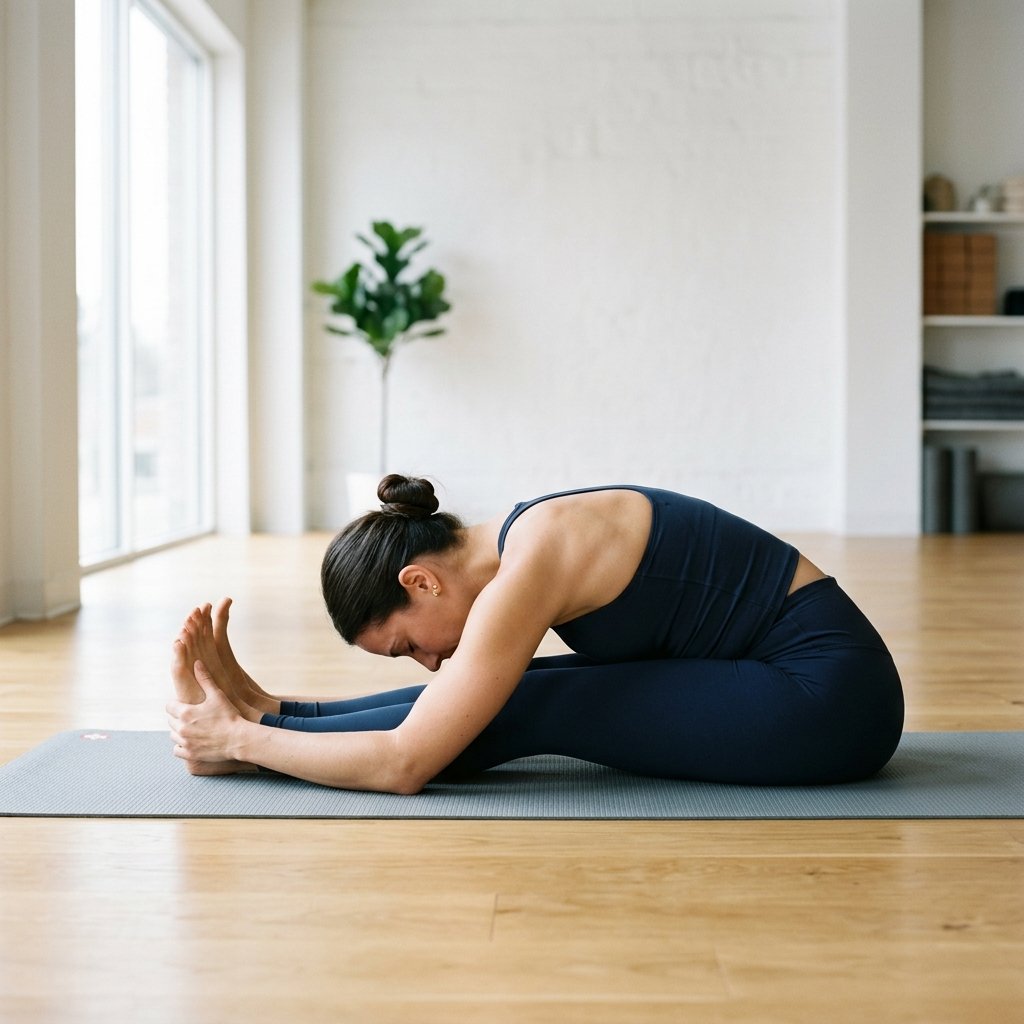
Sit with legs extended straight in front of you, hands beside the hips, and flex the feet.
- Step 2
Inhale and lengthen the spine tall, rolling slightly forward onto the sitting bones.
- Step 3
On an exhale, hinge forward from the hips, keeping the spine as long as possible rather than rounding.
- Step 4
Hold onto the shins, ankles, feet, or a strap around the feet, wherever the fold naturally allows.
- Step 5
Keep a soft bend in the knees if the hamstrings are tight, letting the fold deepen only as the body allows.
- Step 6
Relax the neck and shoulders and hold for five to ten slow breaths, releasing a little deeper on each exhale.
Contraindications
Because Paschimottanasana asks for sustained spinal flexion with the legs locked straight in front of the body, it carries meaningful contraindications for anyone with existing disc, nerve, or lower-back conditions.
Herniated or slipped disc
Deep forward flexion of the spine, especially combined with hamstring tension pulling on the pelvis, can increase pressure on an already-compromised disc.
Sciatica or acute lower-back pain
Rounding forward while the legs are straight can aggravate nerve irritation running down the leg.
Pregnancy, particularly beyond the first trimester
Deep abdominal compression against the thighs becomes uncomfortable and unnecessary as the belly grows.
Diarrhea or an upset stomach
Traditional guidance cautions against strong abdominal compression during digestive distress.
Precautions & Common Mistakes
The single most common and most important mistake in this pose is trying to fold from the upper back and shoulders in order to get the head or chest closer to the legs, which rounds the entire spine into a shape that puts real strain on the lower back and does very little for actual hamstring flexibility. The fold should originate from the hip joints, with the spine staying as long as possible for as long as possible; it's far better to stop the fold early with a flat back than to go deeper with a rounded one. Second, many students keep the legs rigidly straight even when the hamstrings are clearly too tight to allow that without rounding the spine; a soft bend in the knees is not a lesser version of the pose, it's the correct version of the pose for a body that isn't ready for straight legs yet, and the bend can be released gradually over weeks and months as flexibility develops. Third, resist the urge to grab the feet and pull the torso forward using arm strength; this yanks the spine into a position the hamstrings and hips haven't actually opened enough to support safely, and it's one of the more common ways people strain their lower backs in yoga generally. The arms and hands should follow the fold created by the hips and hamstrings, not create the fold themselves.
Modifications, Props & Related Asanas
Sitting on the edge of a folded blanket lifts the hips slightly above the knees, which makes it noticeably easier to hinge from the hips with a long spine rather than rounding, and it's one of the simplest, most effective adjustments available for tight-hipped or tight-hamstringed practitioners. A yoga strap looped around the feet, held with both hands, allows the arms to stay long while the torso folds only as far as the hips and hamstrings genuinely allow, which is far safer than reaching for the feet directly and compensating with a rounded spine. Keeping the knees bent as much as needed, even significantly bent, is a completely legitimate long-term modification, not just a beginner's stepping stone. Paschimottanasana pairs naturally with backbends like Bhujangasana or Setu Bandhasana as a counterpose in either direction, and it shares its hip-hinging mechanics with standing forward folds elsewhere in the practice.