Easy Pose
सुखासन · Sukhasana (soo-KAH-sah-nah)
seated · beginner
| Sanskrit Name & Meaning | सुखासन (Sukhasana (soo-KAH-sah-nah)) |
|---|---|
| Category | Seated |
| Level | Beginner |
| Key Benefits | Opens the hips and lengthens the spine, Provides a stable base for breathing exercises and meditation, Encourages steady, even, diaphragmatic breathing, Builds postural awareness for extended periods of stillness |
| Best Time to Practice | At the start of a practice for centering, or any time as a seat for breathwork (pranayama) or meditation. |
| Contraindications |
|
| Precautions | Sit on a blanket or cushion if the hips are tight, rather than forcing the knees down; Alternate which shin crosses in front from one session to the next; Avoid rounding the lower back to compensate for tired postural muscles during a long hold |
Origin & History
Simple cross-legged seated postures are almost certainly among the oldest positions in the entire yoga tradition, predating the standing and flowing asana sequences by a wide margin, since the earliest textual and iconographic evidence for yoga practice, including seals from the Indus Valley Civilization sometimes interpreted as showing seated meditative postures, and later, extensive discussion in the classical hatha and raja yoga texts, centers overwhelmingly on seated postures used for pranayama (breathing practices) and dhyana (meditation) rather than on physical exercise in the modern sense. Sukhasana specifically represents the accessible, low-barrier end of a spectrum of seated postures that also includes more demanding positions like Padmasana (Lotus Pose) and Siddhasana (Accomplished Pose), both of which require considerably more hip flexibility. As yoga spread to practitioners worldwide, many of whom hadn't grown up sitting on the floor and so had less naturally open hips than practitioners from cultures with that lifelong habit, Sukhasana became an increasingly important, non-negotiable entry point, ensuring that seated practice remained accessible regardless of a student's hip flexibility.
Sanskrit Word Breakdown & Meaning
Sukhasana comes from sukha, meaning "comfort," "ease," or "pleasure," and asana, "pose," giving "easy pose" or "comfortable seat." Interestingly, sukha is also one half of the pairing sthira-sukha found in Patanjali's Yoga Sutras, which describes the ideal quality of any asana as being simultaneously steady (sthira) and comfortable, or at ease (sukha). Sukhasana's name essentially names that second half of the pairing directly, positioning it as the default, accessible seated posture, less demanding on the hips than a full lotus position, but still structured enough to support long, stable stillness for breathing practices and meditation.
Benefits in Detail
Physically, Sukhasana gently opens the hips and outer thighs through the cross-legged position while training the deep postural muscles of the spine to hold an upright position without the support of a chair back, a kind of low-grade postural endurance training that pays off well beyond the yoga mat, particularly for anyone who spends long stretches of the day sitting. Held consistently over time, it can meaningfully improve hip mobility and make more demanding cross-legged positions gradually more accessible.
Mentally, the primary value of this pose is almost entirely in what it enables rather than what it directly does: a stable, comfortable seat is the prerequisite for effective pranayama and meditation, since genuine focus is very difficult to sustain if the body is fidgeting, in pain, or straining to stay upright. By removing physical discomfort as a distraction, Sukhasana creates the conditions for the mind to settle and turn inward, which is precisely why it's so often the opening posture of a class or a personal practice, establishing the physical stability the rest of the session depends on.
Energetically, an upright spine in a cross-legged seated position is considered in the hatha yoga tradition to allow prana to move freely along the central channel of the body, unobstructed by the kind of slumping or leaning that a chair or a soft couch tends to encourage. This uninterrupted, seated verticality is one of the most consistent physical requirements across nearly every meditation tradition that developed alongside or in dialogue with yoga.
Step-by-Step Instructions
- Step 1
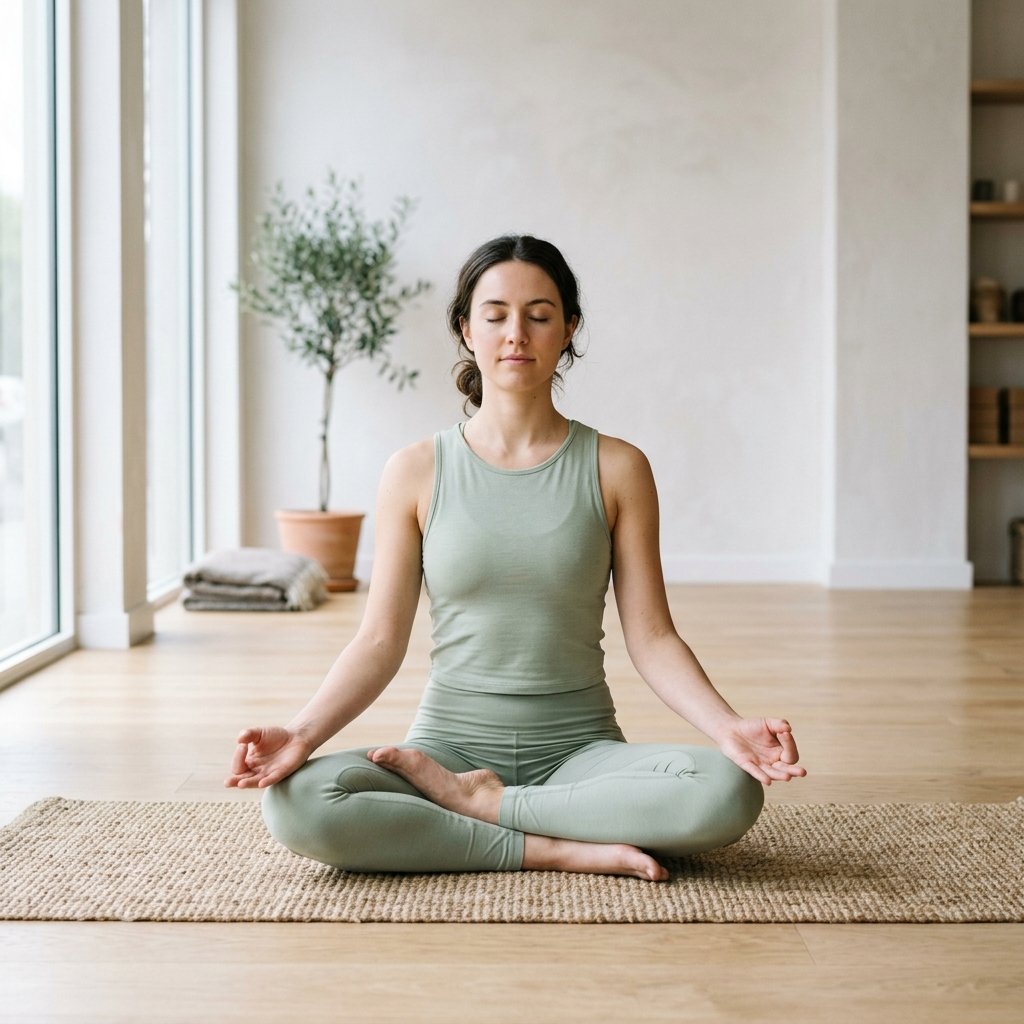
Sit on the floor, or on the edge of a cushion or blanket, with legs extended in front of you.
- Step 2
Bend both knees and cross the shins, allowing each foot to rest beneath the opposite knee.
- Step 3
Check that the knees rest at or below hip height; add height under the hips if they don't.
- Step 4
Lengthen the spine upward from the base, stacking the shoulders directly over the hips.
- Step 5
Rest the hands on the knees, palms up or down, and soften the shoulders away from the ears.
- Step 6
Close the eyes if comfortable and breathe evenly for one to several minutes, or use this seat for meditation or pranayama.
Contraindications
Sukhasana is one of the gentler seated postures, but sustained hip rotation and an unsupported seated spine still create real friction points for a few common conditions.
Knee injury or significant knee arthritis
The cross-legged position folds the knee into a sustained rotated, bent position that can aggravate joint pain or instability.
Sciatica or acute lower-back pain
Sitting on the floor without support often encourages a rounded lower back, which can worsen nerve-related pain in the lower back and legs.
Tight hips causing the knees to sit well above the hips
This posture, while not medically dangerous, tips the pelvis backward and rounds the spine, undermining the pose's purpose; elevation is the appropriate fix rather than pushing through.
Precautions & Common Mistakes
The most common and consequential mistake in Sukhasana is sitting directly on the floor when the hips are tight enough that the knees end up noticeably higher than the hip joints; in that position, the pelvis is pulled into a backward tilt and the lower spine has no choice but to round, which is both uncomfortable and counterproductive for the long, stable holds this pose is meant to support. Elevating the hips on a cushion, block, or folded blanket until the knees can drop at or below hip height solves this almost immediately, and it's worth treating as the default setup rather than an occasional accommodation. Second, many students let one shoulder or hip habitually lead, curling slightly to one side without noticing; consciously checking that weight is even through both sitting bones, and alternating which shin crosses in front each time you sit, helps prevent this asymmetry from becoming a fixed habit over time. Third, during longer holds, particularly for breathing or meditation practice, the postural muscles can tire and the spine can gradually slump; rather than forcing a rigid, effortful uprightness the whole time, it helps to periodically re-lengthen the spine with an inhale and let that length settle into something sustainable, checking in every few minutes rather than only at the start.
Modifications, Props & Related Asanas
Sitting on the front edge of a folded blanket, a cushion, or a yoga block is the single most useful modification for this pose and is appropriate for the great majority of practitioners, not just those with especially tight hips; it does more to protect the lower back during long holds than almost any other adjustment. For anyone who finds any cross-legged position uncomfortable on the knees or hips, sitting upright in a chair with the feet flat on the floor achieves the same core purpose, a stable, tall spine for breathing or meditation, without the hip demand at all. A folded blanket placed under one or both knees for extra support can help if one hip is noticeably tighter than the other. Sukhasana is the gateway to the entire family of seated meditation postures, including Padmasana and Siddhasana, and it's frequently the seat used for Paschimottanasana's warm-up or for extended pranayama practice.