Corpse Pose
शवासन · Savasana (shah-VAH-sah-nah)
restorative · beginner
| Sanskrit Name & Meaning | शवासन (Savasana (shah-VAH-sah-nah)) |
|---|---|
| Category | Restorative |
| Level | Beginner |
| Key Benefits | Allows the nervous system to shift into full rest, Integrates the physical and mental effects of a practice, Lowers heart rate and blood pressure through deep relaxation, Reduces stress, fatigue, and mental agitation |
| Best Time to Practice | Always at the end of a physical practice, ideally held for five to fifteen minutes without rushing. |
| Contraindications |
|
| Precautions | Use a blanket to stay warm, since body temperature drops during deep relaxation; Come out of the pose slowly, rolling to one side before sitting up; Support the lower back with a rolled blanket or bolster under the knees if it feels uncomfortable |
Origin & History
Savasana appears in the classical hatha yoga texts, including the Hatha Yoga Pradipika, which describes lying flat on the back like a corpse as a method for relieving fatigue and calming the mind, indicating that this pose, unlike many of the standing and flowing shapes developed more recently, has genuinely ancient roots within the seated and restorative branch of the yoga tradition. As physical, flow-based yoga practices developed and intensified through the 20th century, Savasana took on an increasingly important structural role: the closing pose that allows the nervous system to process and integrate the physical exertion that came before it. Teachers across virtually every lineage and style, from the most vigorous power yoga classes to the gentlest restorative sessions, treat it as a non-negotiable closing element, widely considered the pose in which much of the actual physiological benefit of a physical practice consolidates.
Sanskrit Word Breakdown & Meaning
Savasana comes from shava, meaning "corpse" or "dead body," and asana, "pose," giving the literal and somewhat startling translation "corpse pose." The name isn't meant to be morbid so much as precise: the instruction is to lie as still and as completely released as a body with no more effort left to spend, letting go of any residual muscular tension, controlling, or performing. It's widely considered one of the most difficult poses in the entire practice to do well, not because of any physical demand, but because genuinely releasing all effort, including the subtle effort of trying to relax, is a real skill that most people have to build over time.
Benefits in Detail
Physically, Savasana allows the body to shift fully into the parasympathetic, rest-and-digest nervous system state after the more sympathetically-activating work of a physical practice, whether that practice was gentle or vigorous. Heart rate and blood pressure typically drop, muscle tension releases, and breathing slows and deepens on its own without any active control. This isn't simply pleasant, it's an important part of how the body actually absorbs the strength and flexibility work done earlier in a session; skipping this integration phase is one of the more common reasons people feel like a practice was incomplete even after a demanding sequence of postures.
Mentally, the pose asks for a very specific and somewhat paradoxical skill: active, alert non-doing. The mind stays awake and aware rather than falling asleep, but without directing, controlling, or narrating anything, a state that closely overlaps with formal meditation practice even though Savasana itself is technically a physical posture. Regular practice of this kind of alert stillness has been widely reported to reduce everyday anxiety, improve sleep quality, and build a general capacity to settle the nervous system on demand, a skill that transfers well beyond the yoga mat into ordinary stressful moments.
Energetically, Savasana is considered the pose in which prana, having been moved and redistributed throughout the body by the preceding practice, is allowed to settle and integrate without further disturbance. Many teachers describe it as the pose where the actual yoga happens, with everything before it simply preparation for this state of complete, aware stillness.
Step-by-Step Instructions
- Step 1
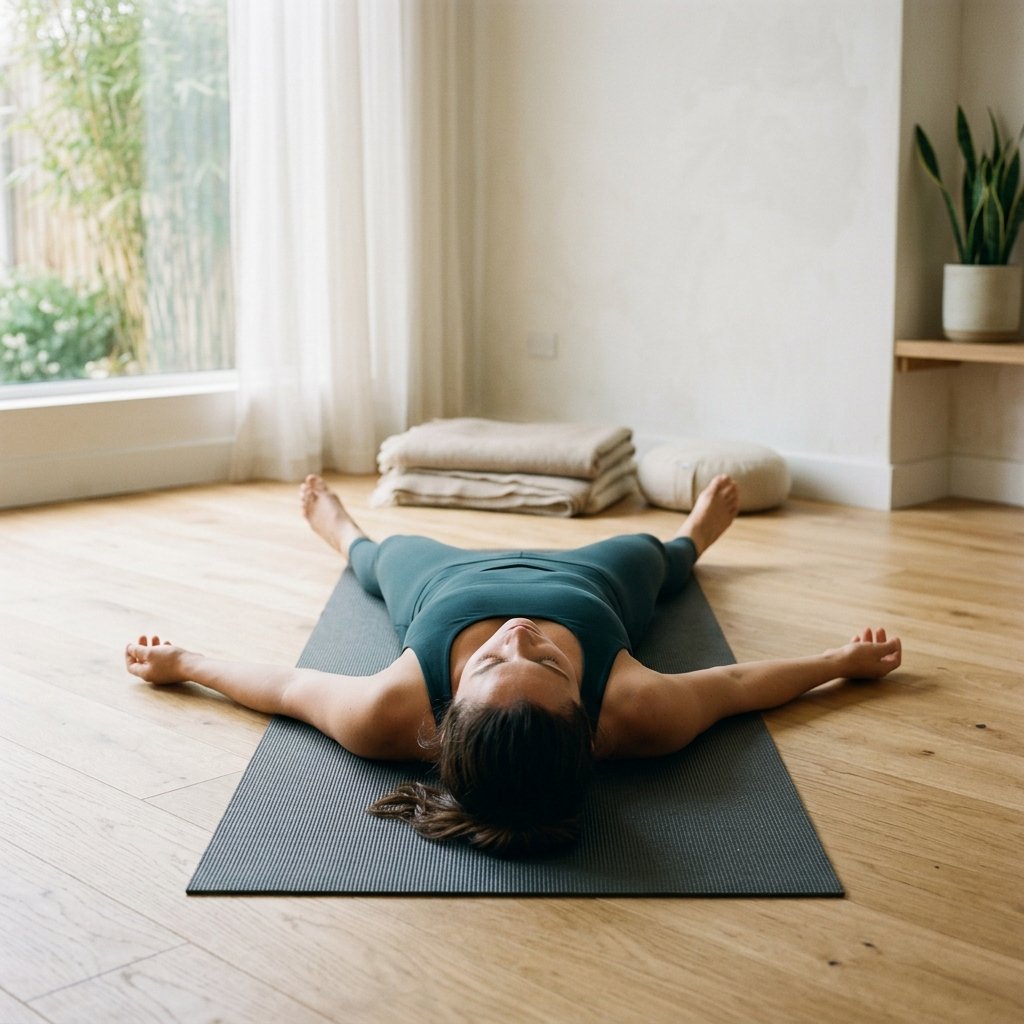
Lie flat on your back, legs extended and relaxed, letting the feet fall open naturally to the sides.
- Step 2
Rest the arms alongside the body, palms facing up, a comfortable distance from the torso.
- Step 3
Close the eyes and take a few slow, deliberate breaths, consciously releasing tension with each exhale.
- Step 4
Scan the body from feet to head, softening any area still holding tension without moving it.
- Step 5
Let the breath return to its own natural rhythm, without controlling or deepening it further.
- Step 6
Rest for five to fifteen minutes, then deepen the breath, wiggle the fingers and toes, and roll to one side before sitting up.
Contraindications
Savasana is about as gentle as postures get, so its few contraindications relate almost entirely to lying flat on the back for an extended period rather than to the pose demanding anything physically.
Late-term pregnancy
Lying flat on the back for an extended period can compress major blood vessels and reduce blood flow; lying on the side with support is the standard adjustment.
Severe respiratory difficulty when lying flat
Some respiratory or cardiac conditions make lying completely flat uncomfortable or unsafe without elevation.
Acute lower-back pain
A flat back position without support can increase discomfort for some people; a bolster under the knees usually resolves this.
Precautions & Common Mistakes
The most common mistake with Savasana isn't a physical alignment error, it's rushing it, treating it as an optional few seconds to check before grabbing a water bottle and leaving, rather than as the essential closing practice it actually is. Five minutes is a reasonable minimum after a substantial physical practice, and longer is generally better. A second common issue is genuinely restless or fidgety students, who unconsciously keep making small adjustments, scratching an itch, shifting a leg, that prevent the nervous system from ever settling into the deep stillness the pose depends on; noticing the urge to move and, where safe, simply staying still through it is part of the actual practice. Third, many people get cold during Savasana as their body temperature naturally drops during deep relaxation, and being cold is one of the more common reasons people cut the pose short; keeping a light blanket nearby solves this easily. Finally, coming out of the pose too abruptly, sitting straight up, can cause head rush or disorient the nervous system right after it settled; rolling gently onto one side and pausing there for a breath or two before slowly coming up to sitting is the traditional, and considerably gentler, way to transition out.
Modifications, Props & Related Asanas
A rolled blanket or bolster placed under the knees releases tension in the lower back for anyone who finds lying completely flat uncomfortable there, and it's a modification worth using freely rather than saving for when pain is already present. A folded blanket under the head can ease neck strain for those with a more pronounced forward head posture. For late pregnancy or anyone who finds lying flat on the back uncomfortable or medically inadvisable, lying on the left side with a pillow between the knees and another supporting the head achieves a very similar restful, restorative effect. An eye pillow or folded cloth over the eyes can help the nervous system disengage from visual stimulation more easily. Savasana is the natural closing counterpart to every other pose in this encyclopedia; it's traditionally practiced at the end of any physical sequence, regardless of which asanas came before it.