Tadasana
ताडासन · Tadasana (tah-DAH-sah-nah)
standing · beginner
| Sanskrit Name & Meaning | ताडासन (Tadasana (tah-DAH-sah-nah)) |
|---|---|
| Category | Standing |
| Level | Beginner |
| Key Benefits | Improves posture and spinal alignment, Strengthens thighs, knees, and ankles, Builds body awareness for every other standing pose, Calms the mind through steady, even breathing |
| Best Time to Practice | Morning, as the opening pose of a practice, or any time you need to reset your posture during the day. |
| Contraindications |
|
| Precautions | Don't lock the knees rigidly straight; keep a soft micro-bend; Avoid gripping the toes or clawing the floor with the feet; Keep the ribs stacked over the pelvis instead of thrusting them forward |
Origin & History
Tadasana is deceptively simple to describe and surprisingly demanding to do well, which is probably why it survived so many centuries of transmission largely unchanged. Standing postures in general are a relatively modern addition to the yoga asana repertoire compared to seated and cross-legged positions, which dominate the earliest hatha yoga manuals from the medieval period, texts that were far more concerned with seated meditation postures, breath retention, and internal energy locks than with the standing sequences most people associate with yoga today. The standing pose vocabulary we now take for granted, Tadasana included, was substantially developed and systematized in the early-to-mid 20th century, particularly through the teaching lineage of Tirumalai Krishnamacharya in Mysore and the students who carried his work forward, including B.K.S. Iyengar and Pattabhi Jois. Krishnamacharya drew on gymnastics, wrestling training, and older hatha yoga fragments to build a more dynamic, standing-centered vinyasa practice suited to the young students in his care. Tadasana became the reference point for that entire vocabulary: the shape every warrior pose, every triangle, every forward fold either returns to or measures itself against. Iyengar in particular treated it as the single most important posture in the practice, the one where alignment principles could be isolated and studied without the added complexity of a bend, twist, or balance challenge layered on top.
Sanskrit Word Breakdown & Meaning
Tadasana comes from two Sanskrit roots: tada, meaning "mountain," and asana, meaning "seat" or "posture." Put together, the name doesn't just describe a shape, it describes a quality of being. A mountain doesn't strain to stay upright. It simply is upright, unmoved by the weather passing over it, its base wide and settled into the earth while its peak reaches quietly skyward. That's the felt sense teachers are pointing to when they cue Tadasana: not a stiff, soldier-like stance, but an effortless verticality, rooted below and open above. Some older hatha yoga texts refer to a closely related standing posture as Samasthiti — "even standing" or "equal standing" — and in many modern lineages the two names are used almost interchangeably for the same foundational shape, with Tadasana emphasizing the mountain-like stillness and Samasthiti emphasizing the symmetry of weight through both feet.
Benefits in Detail
On the physical level, Tadasana is really a posture audit disguised as a resting pose. Standing still and paying attention exposes habits that usually go unnoticed: a hip that rides higher than the other, shoulders that round forward, weight that collapses into the outer edges of the feet. Practicing the pose regularly, and correcting these patterns each time, gradually strengthens the small stabilizing muscles around the ankles and knees, engages the quadriceps enough to support the knee joint without hyperextending it, and encourages the deep postural muscles along the spine to do their job instead of letting momentum or poor habit carry the load. Over weeks and months this can meaningfully improve everyday posture, which in turn reduces the kind of chronic, low-grade back and neck strain that comes from spending hours slouched at a desk.
Mentally, Tadasana works on the nervous system through sheer stillness. There's nowhere to hide in the pose. No forward fold to lean into, no twist to distract the mind, just the plain fact of standing upright and breathing. That simplicity is exactly what makes it useful for building present-moment awareness; many teachers use it as a brief reset between more demanding postures precisely because it gives the mind a stable, undramatic point to return to.
Energetically, in the language of hatha yoga, Tadasana is associated with cultivating steadiness (sthira) as the counterpart to ease (sukha), the two qualities Patanjali's Yoga Sutras describe as defining any well-practiced posture. Standing tall with even weight through both feet and a long spine is thought to allow prana, the subtle life-force energy, to move without obstruction along the central channel of the body, which is part of why the pose is traditionally used to open a practice rather than close one.
Step-by-Step Instructions
- Step 1
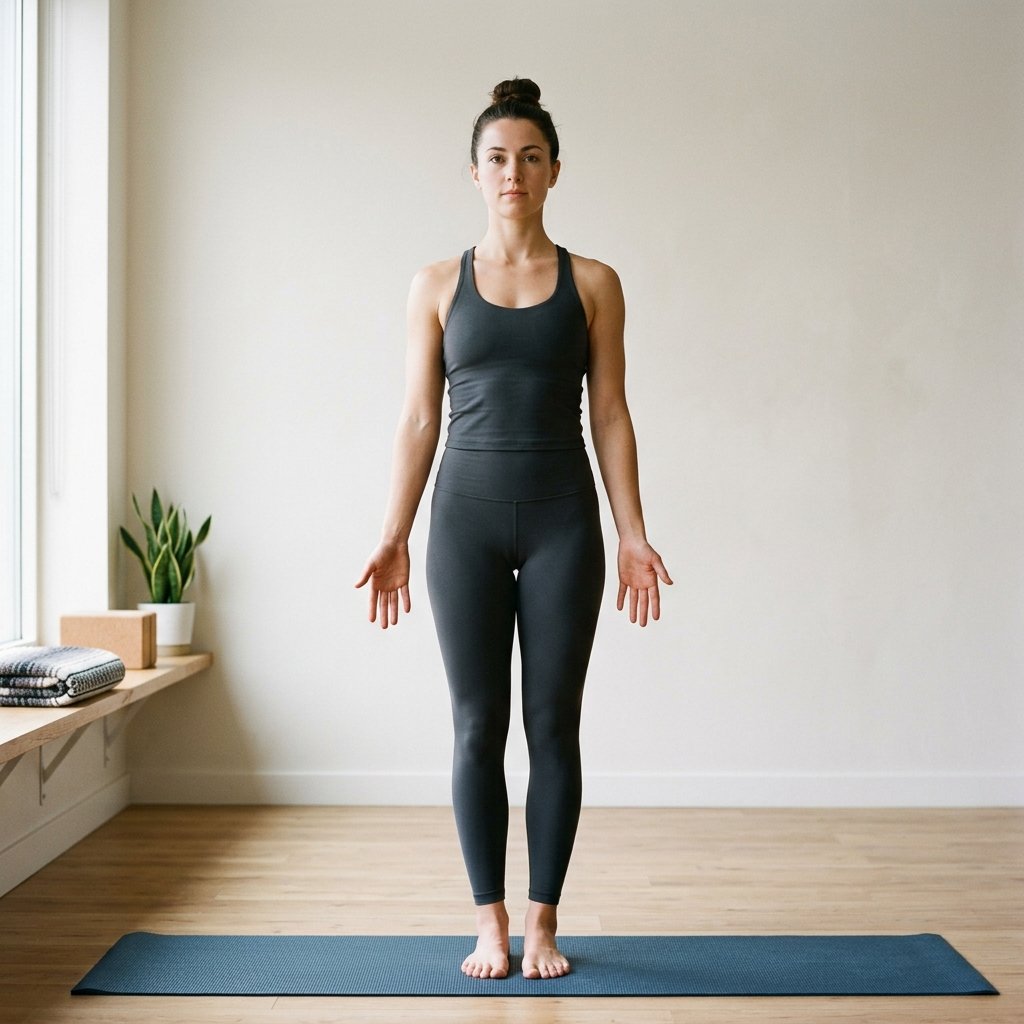
Stand with your big toes touching or feet hip-width apart, weight spread evenly across all four corners of both feet.
- Step 2
Engage the thighs gently and lift the kneecaps without locking the knees; lengthen the tailbone down toward the floor.
- Step 3
Draw the shoulder blades down and back, letting the chest open naturally without flaring the front ribs forward.
- Step 4
Lengthen the crown of the head toward the ceiling, keeping the chin level and the throat soft.
- Step 5
Optionally, inhale and reach the arms overhead, palms facing each other, without letting the ribs pop forward.
- Step 6
Hold for five to ten slow breaths, feeling the dual sense of grounded feet and a lifted spine.
Contraindications
Tadasana is about as low-risk as postures come, which is exactly why it's taught to complete beginners on day one. Still, "low-risk" isn't "risk-free," and a handful of situations call for a modified approach or a different pose altogether.
Low blood pressure with dizziness
Standing still for an extended time can make lightheadedness worse if blood pressure is already low.
Headache or migraine in progress
The stillness and inward focus can sharpen awareness of head pain; it's usually more comfortable to rest instead.
Insomnia (if practiced as vigorous, energizing breathwork alongside it)
Pairing Tadasana with stimulating breath late in the day can counteract the wind-down you're trying to achieve before bed.
Precautions & Common Mistakes
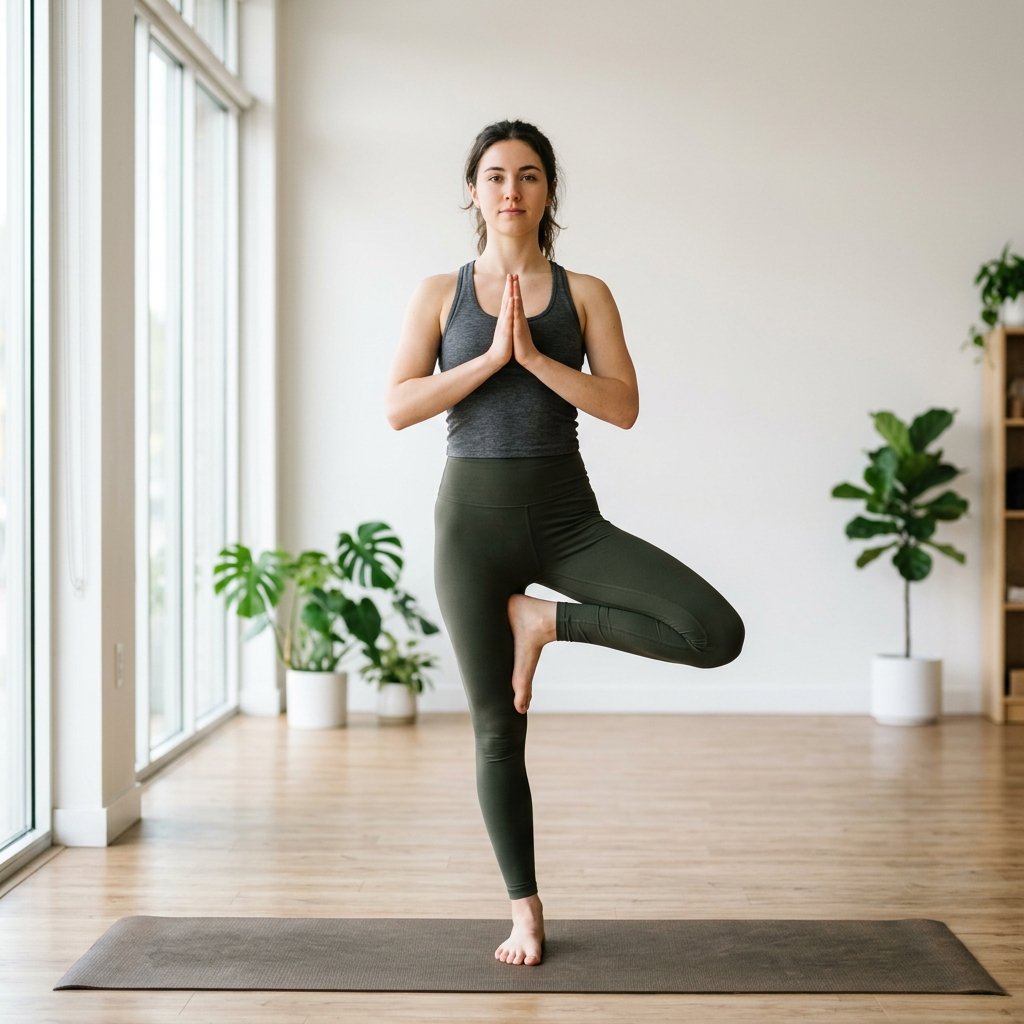
The most common mistake in Tadasana isn't doing too much, it's doing too little attention with too much muscular effort. Many students lock the knees back into hyperextension the moment they're told to "stand up straight," which actually destabilizes the joint rather than strengthening it; the fix is a soft, almost imperceptible micro-bend that keeps the quadriceps quietly engaged instead of letting the skeleton take all the load. A second frequent error is confusing an open chest with a flared ribcage: pushing the front ribs forward creates a false sense of "good posture" while actually increasing compression in the lower back. The ribs should stack directly over the pelvis, not in front of it. Third, watch the feet. Gripping the floor with the toes or rolling onto the outer edges both throw off the even, four-cornered weight distribution the pose is built on. Finally, resist the urge to treat Tadasana as a throwaway pose to rush through on the way to something more interesting; five slow, attentive breaths here do more for the rest of your practice than people expect.
Modifications, Props & Related Asanas
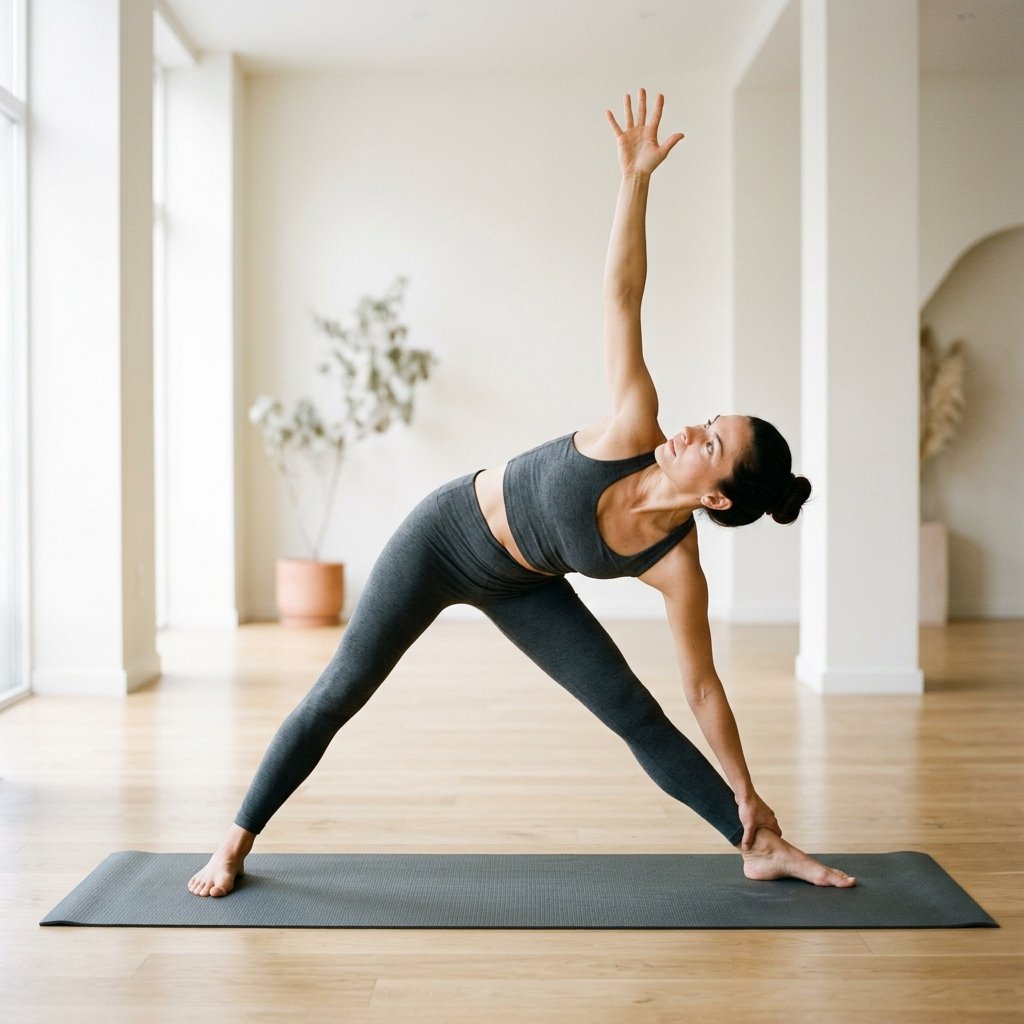
If standing unsupported is uncomfortable or unsteady, Tadasana can be practiced with the back lightly touching a wall, which gives immediate, honest feedback about whether the shoulders and head are actually stacked over the pelvis or drifting forward, a very common pattern. Those with balance concerns, including some pregnant students in later trimesters, can practice with the feet a little wider than hip-width for a broader, more stable base, or with a chair nearby for light fingertip support. For anyone who finds forearms and hands go tingly with the arms extended overhead, simply lower the arms to shoulder height, or rest the hands on the hips instead; the postural benefits of the pose come from the length through the spine, not the position of the arms. Tadasana is the direct entry point into the entire family of standing poses, most obviously Vrikshasana (Tree Pose), which is simply Tadasana with one foot lifted, and Trikonasana (Triangle Pose), which begins from the same evenly-grounded stance before the torso hinges to the side.