Tree Pose
वृक्षासन · Vrikshasana (vrik-SHAH-sah-nah)
balance · beginner
| Sanskrit Name & Meaning | वृक्षासन (Vrikshasana (vrik-SHAH-sah-nah)) |
|---|---|
| Category | Balance |
| Level | Beginner |
| Key Benefits | Improves balance and ankle, knee, and hip stability, Strengthens the standing leg and core, Builds focus and present-moment concentration, Opens the hips of the bent, lifted leg |
| Best Time to Practice | Mid-practice once the body is warmed up through a few standing poses; balance postures generally aren't ideal as the very first thing you do. |
| Contraindications |
|
| Precautions | Never rest the lifted foot directly on the side of the knee joint; Keep the standing leg's knee soft, not locked; Use a wall or chair for support rather than forcing balance without help |
Origin & History
Standing balance postures modeled on natural forms, animals, trees, are a recurring theme in the asana vocabulary that expanded significantly during the early-to-mid 20th century codification of modern postural yoga, again largely traced to Krishnamacharya's Mysore teaching and the lineage of students who documented and disseminated his system, including Iyengar's highly detailed alignment-based approach, which treated balancing postures like Vrikshasana as important tools for developing the kind of precise, sustained attention that carries over into meditation. While single-leg standing postures likely have older roots in various regional physical culture and yogic traditions across India, the specific, standardized form of Vrikshasana taught today, one foot planted, the other sole pressed to the inner thigh or calf, hands at heart center or reaching overhead, is largely a product of this modern systemization, and it has since become one of the most universally recognized yoga poses outside the yoga community itself, frequently used as visual shorthand for yoga in general.
Sanskrit Word Breakdown & Meaning
Vrikshasana comes from vriksha, meaning "tree," combined with asana, "pose." It's another of the more literal, image-based names in the asana vocabulary: the standing leg becomes the trunk, rooted into the earth, while the bent leg and the arms overhead suggest branches reaching outward and upward. Trees appear repeatedly as a metaphor across Indian philosophical and spiritual literature, valued for a very specific quality: they are simultaneously deeply rooted and highly flexible, able to bend significantly in strong wind without breaking, because the root system beneath the surface is doing most of the stabilizing work. That's precisely the balance the pose is trying to teach the body and the mind together, stability that comes from a stable base, not from rigid effort higher up.
Benefits in Detail
Physically, Tree Pose is fundamentally a strength and stability exercise disguised as a stretch. The standing leg has to recruit the small stabilizing muscles around the ankle and the hip abductors and adductors around the hip joint far more than it would during ordinary two-footed standing, which over time meaningfully improves balance and joint stability, a benefit with real practical value as people age, since fall prevention is closely tied to exactly this kind of single-leg stability training. The lifted leg, meanwhile, gets a passive but genuine stretch through the inner thigh and hip as the hip rotates externally to bring the sole of the foot to the standing leg.
Mentally, balance poses in general demand a very particular kind of attention: soft, sustained, and continuously self-correcting, rather than the sharp, effortful focus needed for something like a difficult arm balance. Because losing focus even briefly usually means losing the balance itself, Vrikshasana becomes a fairly direct, honest feedback loop for the state of your attention on a given day, which is exactly why so many teachers use it as an informal check-in point partway through a class.
Energetically, the tree's simultaneous rootedness and reach is often described in yogic terms as a balance between apana, the grounding, downward energy, and prana, the more expansive, upward-reaching energy, held in a single stable shape. Cultivating that balance is considered valuable well beyond the mat, as a template for staying both grounded and open under everyday pressure.
Step-by-Step Instructions
- Step 1
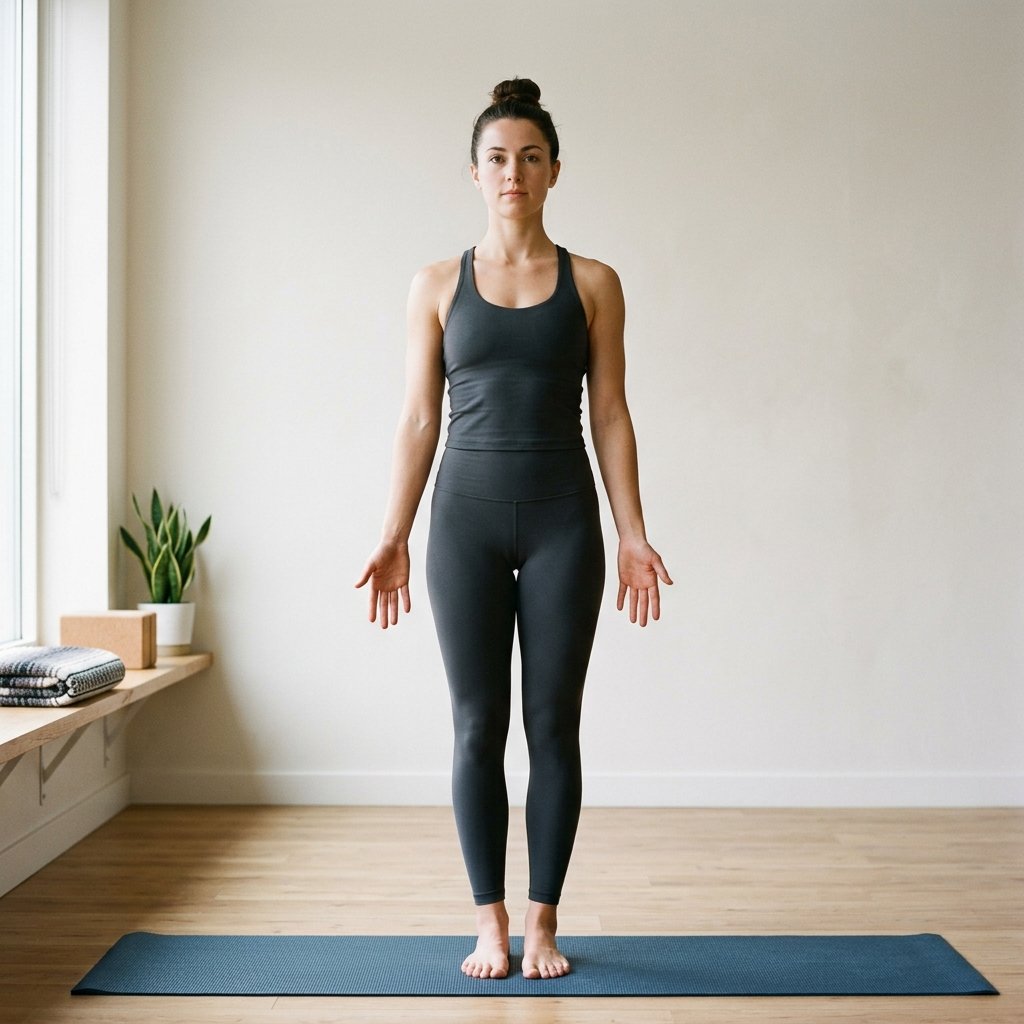
Begin standing in Tadasana, feet together, weight evenly distributed, and pick a fixed point ahead to focus on.
- Step 2
Shift your weight onto the right foot, pressing firmly into the floor through all four corners of that foot.
- Step 3
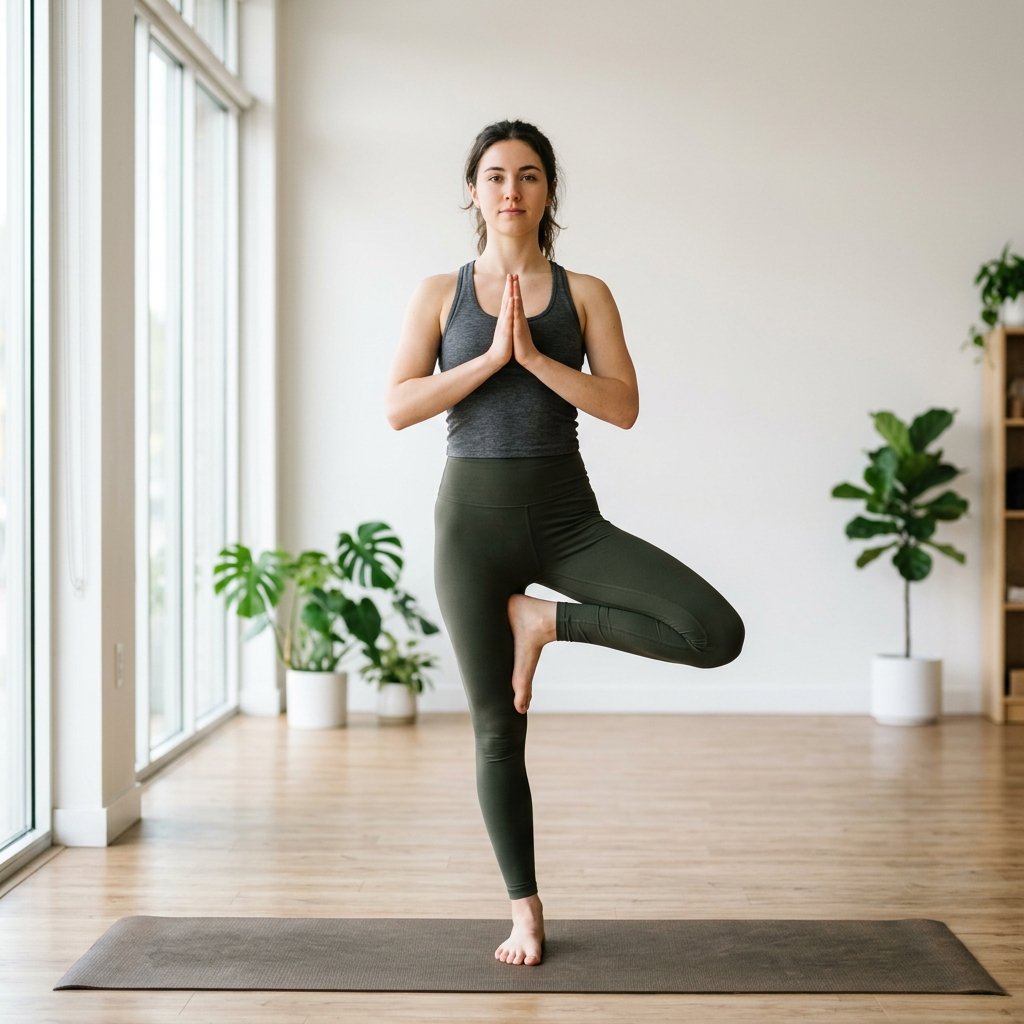
Bend the left knee and place the sole of the left foot on the inner right thigh or calf, never on the knee.
- Step 4
Press the foot and the standing leg into each other evenly to find a stable midline.
- Step 5
Bring the hands to heart center, or, once stable, reach the arms overhead like branches.
- Step 6
Hold for five to eight breaths, then release with control and repeat on the other side.
Contraindications
As a single-leg balance, Vrikshasana concentrates the full weight of the body through one ankle, knee, and hip, so a handful of joint and circulatory conditions call for extra support or a different approach.
Recent ankle, knee, or hip injury on the standing-leg side
The entire body's weight balances through that single leg's joints, which can aggravate an unhealed injury.
Significant dizziness or vertigo
Single-leg balance requires a functioning vestibular system; attempting it during active vertigo increases fall risk.
Uncontrolled low blood pressure
Standing statically on one leg for an extended hold can worsen lightheadedness in susceptible individuals.
Precautions & Common Mistakes
The single most important safety rule in Tree Pose is never resting the lifted foot's sole directly against the side of the standing knee. That joint isn't built to receive lateral pressure, and repeated pressing there, especially under the weight of an entire body trying to balance, can strain the knee's ligaments over time; the foot should rest either above the knee against the inner thigh, or below it against the calf or ankle, never directly on the knee joint itself. A second common mistake is locking the standing knee rigidly straight in an attempt to feel more stable, which actually does the opposite, hyperextension reduces the small stabilizing muscle engagement that real balance depends on; a soft, slightly bent knee is both safer and, counterintuitively, steadier. Third, many students hold their breath while concentrating hard on not falling over; remembering to breathe, slowly and audibly if needed, actually improves balance by keeping the nervous system calm rather than triggering a stress response that makes wobbling worse. Finally, there's no shame in using a wall for a light fingertip touch, or keeping the lifted toes on the floor with just the heel against the ankle; balance is built gradually, and forcing an advanced variation before the foundation is stable is the most common route to a fall.
Modifications, Props & Related Asanas
For anyone newer to balance work, starting with the lifted foot's toes touching the floor beside the standing ankle, heel resting against it, builds confidence with a safety net still in place. A wall behind the back, or a chair held lightly for fingertip support, removes the fear of falling entirely and lets the student focus purely on the leg and hip mechanics. Hands can stay at the heart in prayer position rather than reaching overhead, which lowers the center of gravity and makes the whole pose noticeably more stable; reaching the arms up is an optional intensification, not a requirement. Vrikshasana builds directly on the grounding work of Tadasana, which is essentially the same pose with both feet down, and it serves as a natural stepping stone toward more demanding balance postures elsewhere in a broader practice.