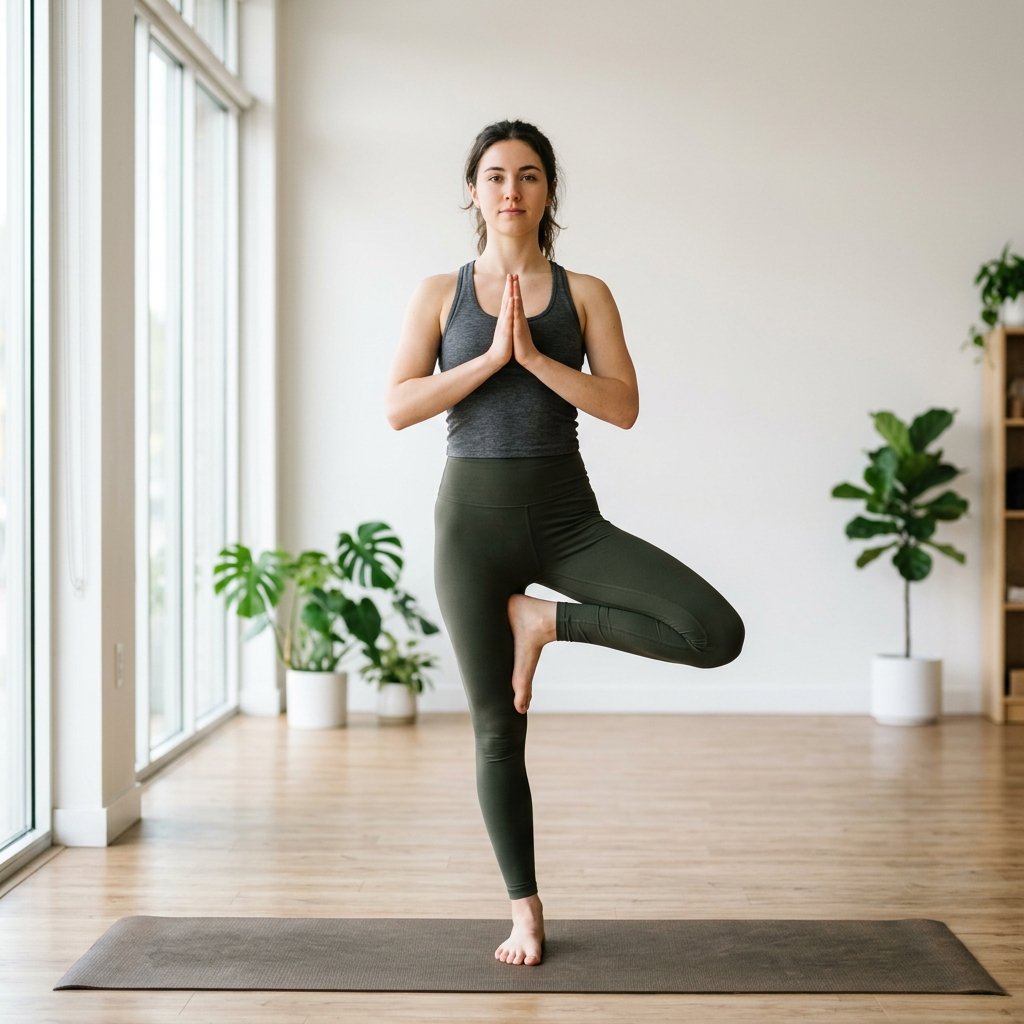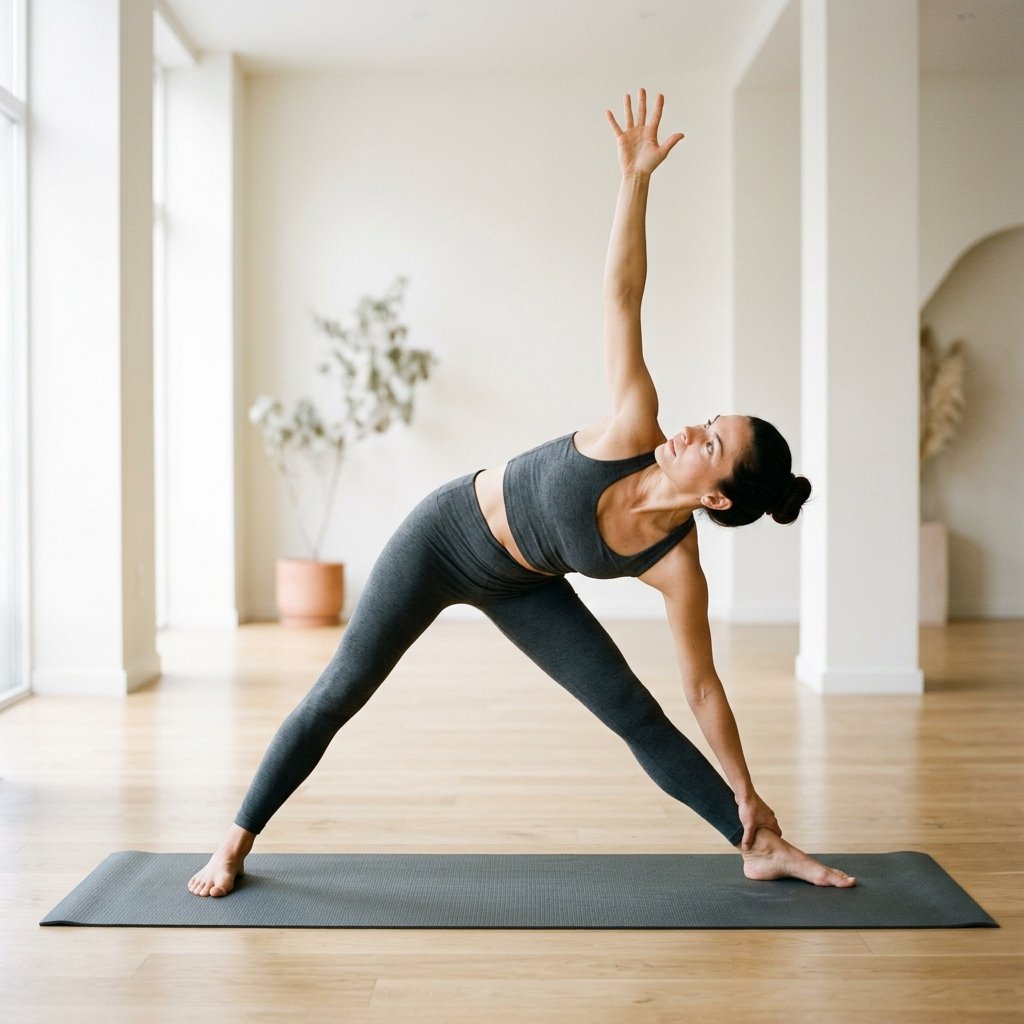
Triangle Pose
त्रिकोणासन · Trikonasana (trik-cone-AH-sah-nah)
standing · beginner
| Sanskrit Name & Meaning | त्रिकोणासन (Trikonasana (trik-cone-AH-sah-nah)) |
|---|---|
| Category | Standing |
| Level | Beginner |
| Key Benefits | Stretches the hamstrings, hips, and side body, Strengthens the legs, knees, and ankles, Improves spinal rotation and lateral flexibility, Can relieve mild backache and improve digestion through the gentle twist |
| Best Time to Practice | Mid-practice, after the legs and hips are warmed up with a few rounds of standing poses or sun salutations. |
| Contraindications |
|
| Precautions | Don't force the bottom hand to the floor at the cost of collapsing the chest; Keep both legs actively engaged rather than locking the front knee; Only turn the head to look up if the neck feels comfortable doing so |
Origin & History
Triangle-shaped standing postures with variations in arm and torso position appear across many strands of physical culture, and the specific form now taught as Trikonasana in most yoga classes was substantially standardized during the same early-to-mid 20th-century period that shaped much of the modern standing asana vocabulary, again closely associated with Krishnamacharya's Mysore lineage and, in particular, with B.K.S. Iyengar's meticulous, alignment-focused teaching, which treated Trikonasana as one of the primary postures for studying how the hips, spine, and shoulders coordinate during a lateral bend. Iyengar in particular was known for teaching multiple careful variations and refinements of this single pose over decades, using it as a vehicle for exploring subtle alignment principles that apply well beyond the pose itself. Its combination of stretch, strength, and mild twist made it a natural fit for the standing sequences that became central to Ashtanga and Vinyasa-style classes as they developed and spread internationally through the latter half of the 20th century.
Sanskrit Word Breakdown & Meaning
Trikonasana combines three roots: tri, meaning "three," kona, meaning "angle" or "corner," and asana, "pose," giving "three-angle pose" or "triangle pose." The name is purely geometric, describing the shape formed by the two legs and the floor, or alternately the shape traced by the extended arms and the line of the torso, depending on which angle of the pose you're looking at. It's a good example of how many asana names describe the visible external form of a posture rather than carrying deeper symbolic or mythological meaning, in contrast to poses named after sages, deities, or animals.
Benefits in Detail
Physically, Trikonasana works the body across several planes simultaneously, which is part of why it's considered such a comprehensive standing pose. The wide stance and straight front leg create a deep stretch through the front-leg hamstring and both inner thighs, while the side bend lengthens the entire lateral line of the torso on the reaching side and compresses it gently on the other, a combination that improves overall spinal mobility in the coronal (side-bending) plane, a direction of movement many everyday activities and even most other yoga poses tend to neglect in favor of forward and backward bending. The back leg and both feet also do real stabilizing work throughout, building ankle and knee strength.
Mentally, the pose demands a kind of full-body coordination, hips, spine, shoulders, gaze, all moving in relation to one another, that tends to sharpen concentration simply because there are several things to track and align at once. Many students also describe a feeling of expansiveness in the pose, the wide stance and extended arms create a large, open shape that can feel emotionally opening as well as physically so.
Energetically, the gentle rotation through the spine and the compression and release pattern in the abdomen are traditionally associated with stimulating digestion and supporting the body's internal detoxification processes, a benefit attributed to many twisting and side-bending postures throughout the hatha yoga tradition, even when, as here, the twist is a secondary component of a primarily lateral-bending shape.
Step-by-Step Instructions
- Step 1
Step the feet wide apart, arms extended out to the sides at shoulder height, forming a T shape.
- Step 2
Turn the right foot out 90 degrees and the left foot in slightly, aligning the right heel with the left arch.
- Step 3
Engage both legs, then hinge the torso sideways over the right leg from the hip, keeping the spine long.
- Step 4
Lower the right hand to the shin, ankle, or a block, and extend the left arm straight up toward the ceiling.
- Step 5
Stack the shoulders vertically and, if comfortable, turn the gaze up toward the top hand.
- Step 6
Hold for five to eight breaths, then rise back up on an inhale and repeat on the other side.
Contraindications
Trikonasana combines a deep hamstring stretch, a side bend that lowers the head below the heart, and often a neck rotation to look upward, three separate reasons the pose needs modification for a number of common conditions.
Low blood pressure or a history of fainting
The head moves below heart level in the final position, which can trigger lightheadedness in those already prone to it.
Neck problems
Turning the head to gaze up at the top hand adds rotational load to the cervical spine that some neck conditions can't tolerate.
Diarrhea or acute digestive upset
Traditional guidance advises against the abdominal compression created by the deep side bend during digestive distress.
Severe or recent hamstring or hip injury
The pose relies on a straight front leg with a hip hinge, directly loading the hamstring and hip of that leg.
Precautions & Common Mistakes
The most frequent mistake in Triangle Pose is treating the bottom hand reaching the floor (or a block) as the goal, which tempts students to collapse the chest forward and round the spine to gain a few extra inches of reach. The actual goal is a long, straight line from the extended back-leg foot all the way through the crown of the head, with the torso hinging directly sideways from the hip rather than folding forward; the bottom hand should rest wherever that line naturally allows, whether that's the shin, an ankle, or a block, and reaching further than that only distorts the pose. Second, many students lock the front knee aggressively straight, which can strain the joint; a small, active engagement in the quadriceps with the knee facing the same direction as the toes, without hyperextending, is both safer and more stable. Third, the back foot is often neglected, when it should be pressing down firmly at roughly a 45- to 90-degree angle to support the whole structure; a disengaged back foot is a common hidden cause of wobbling in this pose. Finally, turning the head to gaze up at the top hand is entirely optional and should only happen if it feels comfortable in the neck; looking straight ahead or down at the floor instead does not diminish the pose.
Modifications, Props & Related Asanas
A block placed on either side of the front foot gives the bottom hand a stable, elevated surface to rest on, which is the standard adjustment for anyone who can't comfortably reach the floor or shin without rounding the spine, and it's worth using even for fairly flexible practitioners who want cleaner alignment. Practicing with the back heel against a wall can help beginners find the correct back-foot angle and prevent the back leg from sliding. For neck sensitivity, keep the gaze forward or down rather than turning to look at the top hand. Trikonasana shares its foundational standing alignment with Vrikshasana and other poses that begin from an evenly grounded stance, and it's often taught alongside Parsvakonasana (Extended Side Angle Pose), which explores a deeper variation of the same side-bending, hip-hinging action.